
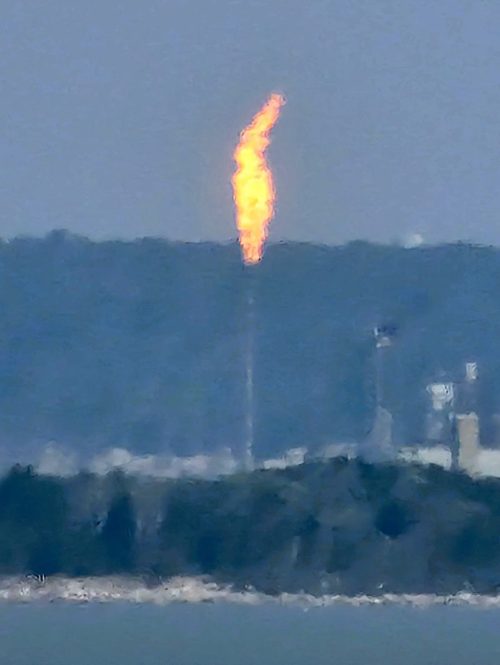
If there’s a reason to move away from fossil fuel fuels this is one of them. Renewable energy must be deployed even faster rate to avoid greenhouse gases such as methane and CO2 to polluting and heating atmosphere even further.
Planet temperature rise, driven by greenhouse gas emissions from burning fossil fuels, reached a record high in 2024, exceeding 1.5°C above pre-industrial levels for the first time. This long-term trend of warming is leading to intensified extreme weather, rising sea levels, and threats to biodiversity, with the past decade being the warmest on record. Source: Copernicus
Global carbon dioxide emissions from fossil fuels and industry totalled 37.01 billion metric tons (GtCO₂) Since 1990, global CO₂ emissions have increased by more than 60 percent (source: Statista)
Flaring
If there’s excess methane or operational upsets, it’s sent to the ‘flare stack’. Flaring converts methane → CO₂ + H₂O, which is still a greenhouse gas (CO₂) but far less potent than methane.
The International Energy Agency (IEA) say:
Flaring results in the release of substantial volumes of potent GHGs, including methane, black soot and nitrous oxide. Venting causes even worse environmental damage than flaring.
Around 140 billion cubic meters (bcm) of gas is flared globally each year. This is a major source of CO2 emissions, methane and black soot, and is damaging to health. In 2022, the volume of gas flared worldwide fell by around 5 billion cubic meters (bcm) to 139 bcm (about 3% reduction). Flaring resulted in 500 Mt CO2 equivalent annual GHG emissions in 2022. Around 70% of gas flared goes to flares that operate on a near continual basis.
Here are some of the effects of global warming:
- Relentless heat: Multiple long heatwaves; thousands of excess deaths across major cities.
- Hot seas: Record marine heatwaves in the Mediterranean and elevated North Atlantic temps, stressing marine life and amplifying coastal heat.
- Wildfires: EU’s worst year on record for burned area (>1 million ha) with hazardous smoke episodes.
- Water & crops: Drought and restrictions hit parts of Europe; summer yield losses in SE/central regions.
- Storms & floods: Powerful winter storms and later flash floods/hail caused widespread damage.
- Alps: Swiss glaciers lost seasonal snow unusually early; permafrost at record warmth (higher rockfall risk).
- Health: Rising vector-borne disease signals (e.g., West Nile).
- Systems impact: Higher cooling demand; record solar output helped but didn’t prevent price spikes during peaks.


Very informative!
LikeLike