

A report by Victor S Ient
April 2024
According to The Office of National Statistics (ONS) report of 2022, households account for approximately 26% of Greenhouse gas emissions. What can be done about this? Here are the changes we have made at our house in Dorset to be CO2 free.
This year, my son and I put the final piece in the jigsaw with regard to renewable energy at our house in Dorset. In 2022, we installed an air source heat pump (ASHP) system, which avoids the house giving off any CO2 global warming gases, as you would have with a gas boiler. Also installed are solar panels. There are a number of advantages to solar panels:
- When the sun is shining, the solar panels generate electricity which is used by whatever device in the house is consuming electricity at that time.
- Solar energy heats the water in the hot water tank via a myenergi eddi converter.
- Solar energy generated from the solar panels is fed into the electricity grid, providing a small income.
Many people may say “why replace a gas boiler as electricity is far more expensive than gas?” … and in the UK, yes it is. This pricing structure is completely artificial. The government could do something about this, but this would require a significant policy change, so it’s unlikely to be corrected in the near future. However, the motivation for changing to an ASHP and solar panels has been a matter of principle for us. Yes, it will take well over 10 years for the financial payback. We are much more comfortable now the installation is complete as, over that 10 year period, the house will not be giving off any global warming gases into the atmosphere. The ASHP is much more efficient than a gas boiler. There is evidence to prove this and I hope to publish another article covering this aspect soon.
We have also removed gas entirely from our home by installing an electric induction hob for cooking. This works efficiently and uses far less energy than a gas hob. A car charger point was installed a few years ago. The car can be charged partly from the battery system rather than using energy directly from the grid. It is also possible to charge the car overnight when electricity is much cheaper.
Battery system for storing electricity
The real benefit comes when a battery system is installed. Batteries store surplus electricity from the solar panels for it to be used by the house at a later date. A GivEnergy 13.5 kW battery system was installed earlier this year. Research shows that this size of battery provides a reasonable capacity to help reduce the amount of electricity taken from the grid. It’s not a complete solution, but combined with the way in which our electricity supplier, Octopus, works, there are significant reductions in the cost of electricity.
Below is a graph of the electricity status in the house from March 2024. We use the ‘Octopus Flux’ tariff, which means to say the battery can be charged at night at a much cheaper rate than during the daytime. Charging times are between 2am and 5am, which is sufficient time to charge the battery should it need a full charge, though often, this is not the case. Also, this system will power the house if the mains electricity goes off.

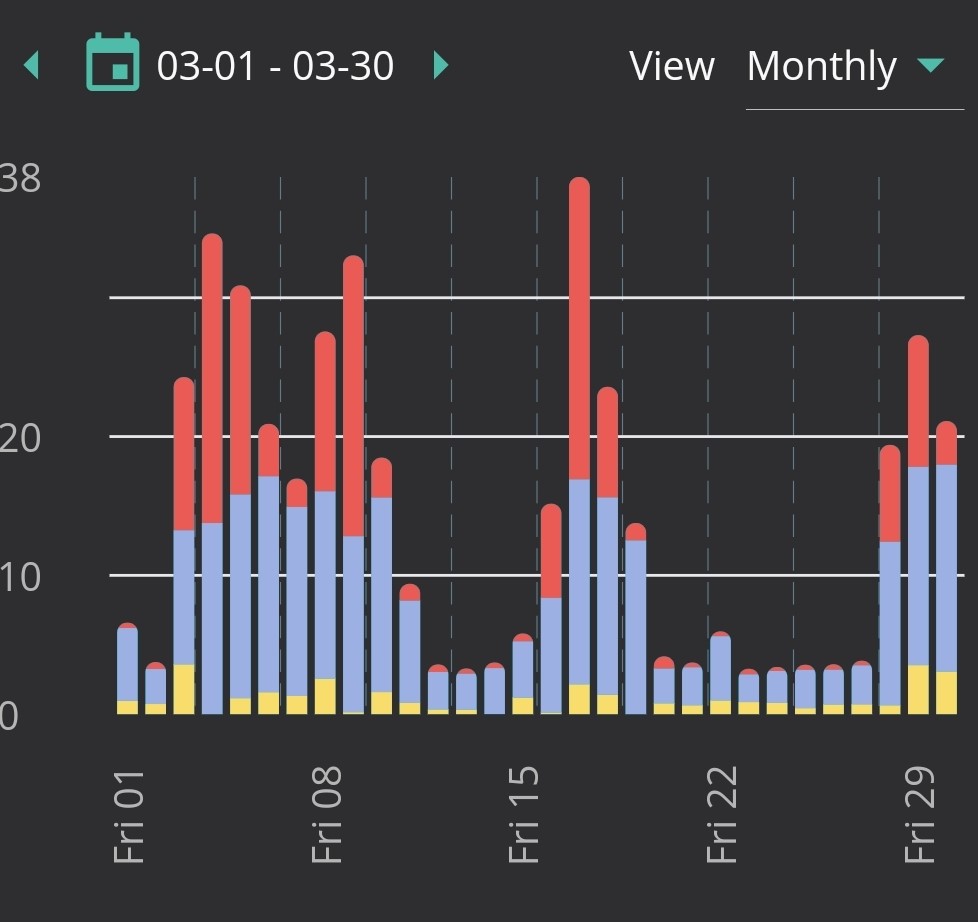
For the month of March, it wasn’t particularly sunny. So, you can see that only 33 kilowatts were generated from the solar panels.
The total consumption for the month of March is 433 kilowatts (kW). But this does not all come directly from the grid at the normal cost per kW. Only 151 kWs has come from the grid at the normal cost per kW. The other 248 kW has come from the battery which is charged during the cheap night rate period from Octopus.
I haven’t yet completed the full calculations because the whole system has only been installed since the beginning of February 2024, but I’m already seeing a drop in the cost of electricity.
Octopus provides a cheap rate from 2am until 5am. Current charges are:
Unit Rate (Day) 32.28p per kW/h
Unit Rate (Night) 13.83p per kW/h
The pie chart at the head of this article shows the share of the UK’s greenhouse gas emissions from different sources in 2020. Source: BEIS

 Campaign for a Better Environment